
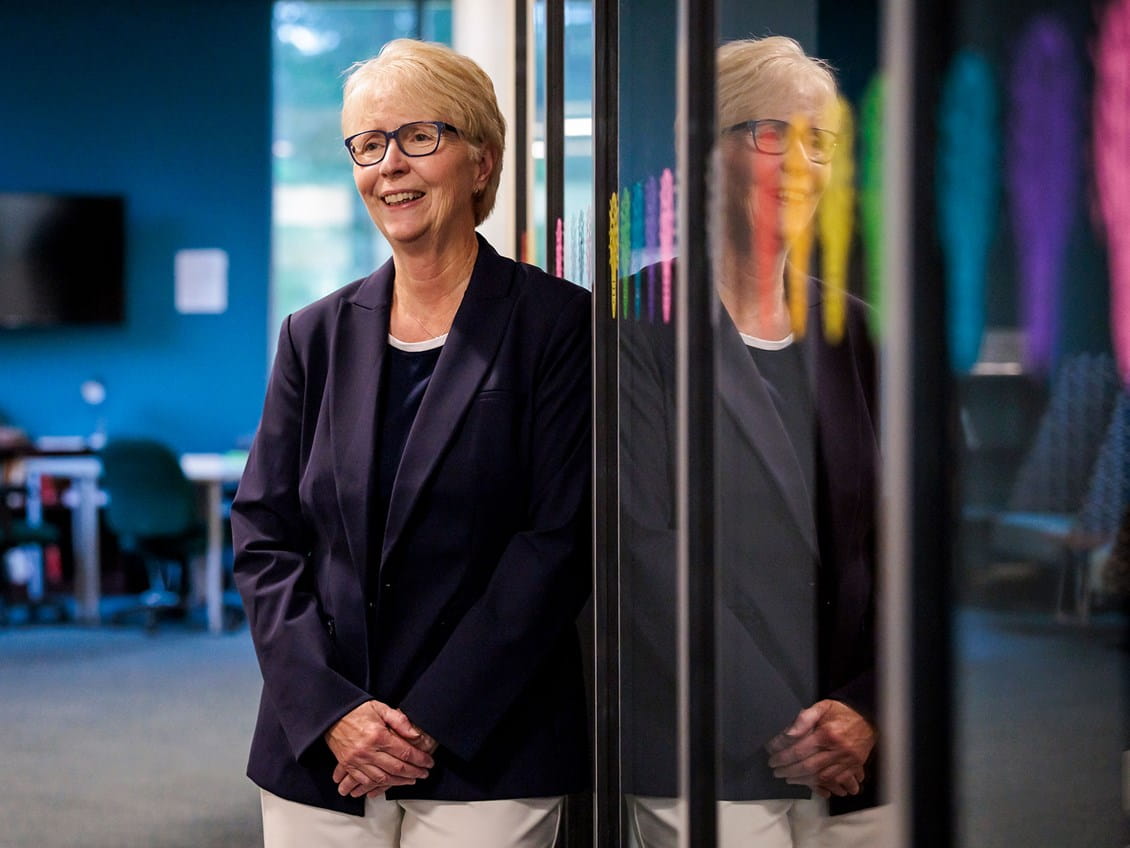
Dr. Deirdre Sartorelli is no stranger to Endicott, which made her the right candidate at the right time to serve as the newest Dean of the Curtis L. Gerrish School of Business, a role she assumed in July 2026.
Through her many roles at the Gerrish School—Assistant Dean, Director of the Angle Center for Entrepreneurship, Entrepreneur-in-Residence, and faculty member—she’s been on the frontlines of helping our students evolve alongside business, while serving as a seasoned business leader herself. Now, with AI revolutionizing the workplace, that evolution has never been more important.
“Several years ago, a former student told me that I had a knack for meeting students where they were and getting them to where they needed to be,” she said.
While that is gratifying for the new dean, Sartorelli said it often involves honest, candid, and sometimes difficult conversations.
“These are opportunities to help our students become who they are meant to be. That is the greatest opportunity. That view hasn’t changed now that I am the dean—it does mean I need to work especially hard at it, as a dean’s day can be very full.”
We recently sat down with Sartorelli to get a glimpse into one of those honest, candid, and sometimes difficult conversations. On a range of topics from AI and the role of the humanities to the future of business education and what employers are seeking, she did not hold back.
Responses have been edited for length and clarity.
You’ve experienced the business world from almost every angle—as an executive, entrepreneur, educator, trustee, and now dean. Which of those experiences most shapes how you think about preparing students for their careers?
Sartorelli: My experience as an executive has likely had the greatest impact on me as I think about our students starting their working lives. That’s because I have a good sense of what works and what doesn’t work—no pun intended!
Here’s the thing. When I think about preparing students, I don’t want a chasm between what they learn in the classroom and what they experience in the actual workplace. That is why our internship program is so strong and popular. It helps them “cross the chasm,” so to speak. Then, when they come back and talk to me about a particular experience they had or engagement they saw, I can help them reflect on it in a meaningful and practical way because of my executive background.
I am also an advocate for employers. I have a good sense of what characteristics they want to see in their employees. Helping students see the workplace from this important perspective is the most meaningful work for me.
AI is already changing what companies need from new graduates. What skills do you believe will become more valuable—not less—as artificial intelligence becomes part of everyday business?
Sartorelli: The skills I see becoming even more valuable are the ones that have always been valuable: empathy, discernment, proactivity, initiative, and, most of all, discipline. Folks who do the best in business are the ones who can proactively make the leap in thinking and go from A to D without pausing on B and C most of the time.
What role should the humanities, communication, and critical thinking play in a modern business education, particularly as AI takes on more technical work?
Sartorelli: I’ve had this conversation with Endicott students. They actually don’t need to be convinced that critical thinking still has an outsized role in modern business education. I love this fact!
They are, in a very healthy way, skeptical about outsourcing their own agency to a machine. This generation has been through a lot, and without having to ruminate on all of that, I’ve got great faith that they understand the importance of being people-centric.
How do we help students on their journey of this awareness? It’s by being exposed to different schools of thought, opposing viewpoints, and by gaining global awareness. That’s why Endicott’s global education program is so important. Our students realize the importance of studying abroad and its impact on becoming “worldly.”
Conversely, we host many international students here on our Beverly campus. In fact, I had dinner with many of them not long ago, and I can assure you that our dinner-table conversation was lively and well-informed. The humanities, good communication skills, and critical thinking help prepare our Endicott students to be well-informed citizens.
You spent much of your career at companies like Verizon, Cisco, and Avaya. What did the best young professionals you encountered have in common, and can those qualities actually be taught?
Sartorelli: Self-awareness and the ability to say “I don’t know,” even when those words might feel scary to say. Actually, those words can be scary to say at any age! I also like to see grit—a willingness to slog through, even when it is hard. The reward is not just the achievement that may be on the other side. The reward is also the journey. Establishing yourself in the workplace can be like that—a marathon and not a sprint.
You’ve hired and managed hundreds of people over your career. What makes a 22-year-old stand out to you in an interview or in their first year on the job?
Sartorelli: I just had this conversation with someone who was going out on an interview! I would like confidence and a strong sense of story from that 22-year-old. I say confidence, not cocky. The latter is a showstopper for most folks and me. By confidence, I mean being comfortable with yourself for where you are at this point in life. Confidence is when someone has both ease with themselves and an eagerness to learn more about a situation.
As for the story, that 22-year-old needs to help me understand their narrative, and they need to do it in an authentic way. A favorite question I like to ask is, “Who is the person who knows you best, and what would they say is your best attribute?” That gives a nice foundation for discovering the candidate’s uniqueness. But I quickly follow that up with, “And what would that same person say you need to work on?” Now, with that answer, we are discovering the candidate’s self-awareness. And the interview will draw to a close pretty quickly if the candidate replies “nothing.”
With the Endicott Experiential Edge in mind, we often talk about shortening the distance between the classroom and the career. What does that idea look like specifically in business education?
Sartorelli: With Endicott’s Experiential Edge, students begin honing actionable skills that can be deployed in the workplace from their very first internship in freshman year. So, what informs our business education so we know what those skills should be? It is our faculty! I’ll put our faculty against any other institution’s. Why? They are practitioners in for-profit corporate settings, professional consultancies, and non-profit organizations today. They bring these battle-tested skills to their academic teaching, thus making learning an immersive experience. And guess what? Students deeply respect this realistic approach to their education. They know it is a differentiator for them when they land that first internship or job. Now the bigger question is: why do employers care about shortening the distance between the classroom and an employee’s career? Because that employee can immediately begin to contribute to that employer’s value proposition and bottom line.
Entrepreneurship has been a major part of your work at Endicott. Even for students who never plan to start a company, what does an entrepreneurial mindset give them?
Sartorelli: The entrepreneurial mindset gives someone permission to be an “innovation agent,” even if they never start a company. Imagine one of our students who has taken our entrepreneurship courses or been involved with the Angle Center for Entrepreneurship lands a job at a large company. You might think these two things don’t go together, but they do! This student will take the business owner mindset with them as they chart their course of action in that company. Who doesn’t want an employee who acts as if they own the company and its positive outcomes? Imagine the advocacy that can be done on behalf of customers, shareholders, and other stakeholders! That mindset can absolutely contribute meaningfully to the firm's success in a way that is a complete differentiator.
Business schools have traditionally taught students how successful organizations operate. In a moment when technology and entire industries are changing so quickly, do we need to spend more time teaching students how to navigate uncertainty, disruption, and even failure?
Sartorelli: Absolutely! And yet, I don’t know that anything has changed here except for the pace of the disruption. Let’s think about it over the past 40 years. We have seen transformative technologies reach into every industry. I’m certain people looked at the advent of email back in the day with a wary eye! Yet now we have generative artificial intelligence today that supports interactions in a very different way from other technologies. And the AI we will have in one year will look very different from the AI we have now.
All this change can be very unsettling, yet nothing ever got done by standing in place. So, how do students navigate what can seem like quicksand? This gets back to my prior answer about grit. If you enter a situation knowing that change is going to happen, you start to develop a resilient mindset. You start to think about alternatives. Now let’s say something happens you hadn’t anticipated, and you have a failure. That failure is still an education and a point where empathy begins to develop. When I think back on my professional failures, they have informed me then and even to this day. That doesn’t mean I like failure, but knowing that professional failures are inevitable means we can start to develop a greater awareness of what is going on around us. It may also mean not being so quick to plant a flag on a particular issue or technology, because we know we need to stay nimble when important new truths come to light or when technology improves.
You’ve worked with students, executives, entrepreneurs, and boards. What are employers telling you they need from the next generation of business leaders that they weren’t necessarily asking for five or 10 years ago?
Sartorelli: Employers will always want technical competence. Yet what they’re telling us now is they want skills in application from the next generation. They want to see judgment, adaptability, and the ability to work well with others right out of the gate. How does a business leader navigate things when the landscape isn’t clear? How can Endicott students entering the workforce work across functions within an organization, and how can they work with multiple generations in the workplace? I hear the word “curious” quite a bit from employers. They want business leaders who are willing to probe the unknown, the uncertain, and the unclear, and to do these things without fear. This may be the biggest change from five or 10 years ago. And those things—the uncertainty, lack of clarity—may manifest during interactions with clients; some of these interactions may be difficult. We teach our Endicott students how to have these discussions, even when they may be hard. Good work can come out of hard conversations.
For someone considering an MBA or another graduate business degree, what should graduate education provide today that professional experience alone can’t? How do you see Endicott’s graduate business programs evolving to meet the needs of working professionals?
Sartorelli: Endicott has always been at the forefront of what I call evergreen curricula at the graduate level. An evergreen graduate curriculum evolves to meet the practical needs of our graduate students and address the challenges they face in the evolving workplace. So, while our programs are exceptionally strong in the academic theories that today’s graduate students need to know, they are equally strong in applying those theories to real-world workplace situations. Imagine you are a graduate student who can tee up a real-world business challenge and get to work on it as part of a project-based learning initiative. You are earning academic credits, and you have something specific and measurable to put on your resume.
The net result of this is that you now get to have a conversation with either your current employer or a prospective one about how you specifically engaged these skills on a real-world problem. It is taking Endicott’s Experiential Edge and using it to transform your graduate education journey. Or perhaps, as a graduate student, you sign up for an immersion program where, alongside other graduate students at one of our global campuses, you work on a real-world business project brought to us by one of our corporate partners. That puts Endicott students squarely in the middle of where things get done. I’m also acutely aware that students can’t wait until the end of their graduate program to develop these skills—they need to learn business skills now as part of their educational journey. Every one of our programs is challenged to ensure its learning outcomes pass the test of “applicability” in the real world.
Imagine we’re having this conversation five years from now. What would need to have happened for you to say, “We really moved the Gerrish School of Business forward”
Sartorelli: Five years from now, we will be known as a business school where learning happens by doing—it’s our Experiential Edge at hyperspeed because that is where the business world is going.
From our inception, Endicott has always been willing to embrace new ways of doing, learning, and teaching. Embracing that can sometimes seem scary. However, growth happens at the edge, and that is true for our College.
We are breaking ground next year for an Innovation Complex to be built here in Beverly. This Complex will be the hub that naturally is the focal point for the innovative and entrepreneurial projects happening here. Naturally, this includes business and STEM, and yet it goes so much further. We will be pulling in the leading-edge work done here at Endicott in behavioral science, education, nursing, sport science, and the humanities. The work of our students and faculty today happens in a collaborative and collective manner. And the Innovation Complex is the way we will express that as an institution.