

After more than two decades in the hospitality sector, Betsy Totten M’24 found herself at a career crossroads, ready to advance but unsure how to fit grad school into an already full life.
While searching for flexible MBA programs, Endicott’s stood out for several reasons. It offered a four-course customizable concentration. It was flexible and hybrid, allowing her to blend in-person and online classes without stepping back from her full-time role. It was competitively priced compared to other programs she researched. And, importantly, it was close to home.
“I thoroughly enjoyed the opportunity to return to the classroom and learn from both my professors and peers,” said Totten, who is a Global Account Executive for Marriott International.
Returning to the classroom sharpened her analytical and communication skills, but it also gave her something she didn’t expect: the chance to mentor.
“As a hospitality professional and leader, I have developed a passion for mentoring and supporting emerging talent, and I have greatly enjoyed the opportunity to share my expertise to help the next generation,” she said.
Totten’s experience is common in Endicott’s MBA program. Students don’t just learn from expert faculty, but from each other: entrepreneurs, working professionals, career-changers, and recent graduates eager to accelerate their paths.
That’s one of the defining characteristics of an Endicott MBA: it’s built for people who are already in motion.
“Most of our MBA students are making a move while they’re already mid-stride,” said Alli McPhedran, Senior Associate Director of Graduate Admissions. “They’re leading teams, changing industries, or trying to level up, and pausing their career for two years isn’t realistic. Our job is to build a program that keeps pace with their life. Flexibility isn’t a perk here, it’s the foundation.”
A flexible MBA that works for working professionals (and beyond)
With eight start dates a year, students start when they’re ready; and because the courses run in six-week blocks, most complete the program in under two years. Some are coming in with a decade (or two) of professional experience. Some are taking the Fifth Year MBA route right after undergrad, sharpening their business acumen before setting foot in a conference room.
And when Endicott talks about “flexible,” it’s not just a label on a brochure. Students can choose 100% online. Hybrid. Even shift formats as their work lives shift. That kind of on-the-ground adaptability is why Totten could move toward a master’s while still managing global accounts Monday through Friday.
The program reflects another theme Totten found herself returning to: the people.
Her cohort welcomed hospitality leaders like her, as well as emerging entrepreneurs, young analysts, engineers, and nonprofit professionals thinking about how to scale impact. Students don’t just learn business case studies from professors—they trade industry intel with each other. And because many faculty are still actively working in their industries, the case studies are contemporary.
That resonated for Yuhao Wu M’24.
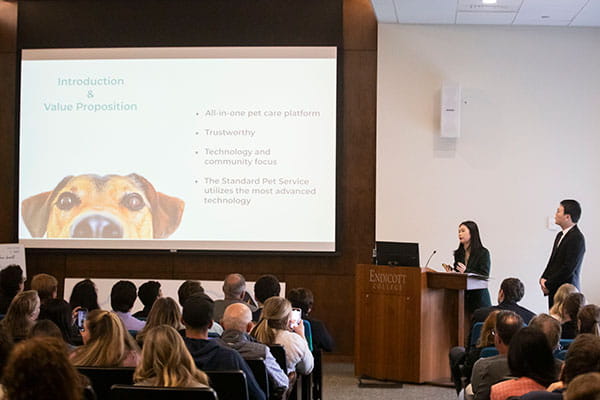
“What impressed me the most was the frequent use of real-world examples by the professors, allowing us to engage in group analyses,” said Wu, who also worked with fellow students and entrepreneurs to compete in the 2024 Spark Tank, sponsored by the Colin and Erika Angle Center for Entrepreneurship. “This hands-on experience not only reinforced classroom learning but also provided valuable practical experience.”
For international students like Wu, the program also offered something intangible but crucial at the start: belonging.
“I was initially nervous about studying abroad,” Wu said. “But I quickly felt the warmth and dedication of the staff during the application process.”
Small class sizes reinforce that sense of community, creating space for meaningful conversation with peers and faculty, and for deeper analysis when those real-world case studies hit the table.
In that way, the MBA also becomes a network, and even a testing ground. Endicott’s Spark Tank competition, for example, invites student innovators each year to pitch ideas to industry pros for seed funding and mentorship. Even the program’s array of concentrations—from Global Hospitality to Healthcare or Sustainability—comes alive differently when classmates are actively wrestling with those issues in real time at work.
“Going back to school has challenged my analytical and communication skills and pushed me to share my professional knowledge to elevate the experience of my classmates,” Totten said.
That connection—to peers, to faculty, to real business problems—seems to be the constant thread. In a landscape crowded with programs that promise convenience, Endicott’s structure is less about stepping away and more about working through. Students stay in their field, keep their jobs, and apply what they’re learning in real time.
That’s why more students are choosing an MBA as a catalyst, not a pause. Not to reinvent who they are, but to sharpen the direction they’re already heading.
Because in the end, an MBA only matters if it moves you forward.
At Endicott, that’s kind of the point.
Jan Soolman contributed to this reporting.