


Whether you're exploring AI coursework, preparing for internships, or navigating professional opportunities, this section provides dynamic support and guidance. Discover tailored resources on AI in the curriculum, responsible usage policies, and skills development to enhance your academic experience and career readiness.
"I think the best thing a student could learn regarding AI is not just the output but figuring out what the appropriate structure of question might be to provide a repeatable and expandable output. At the end of the day AI is a tool that will sink or swim based on the skill level of the person wielding it."
Brett Marshall, Owner and Creative Director, Tradewind
Owner and Creative Director, Tradewind
AI: Theory and Practice Minor
-
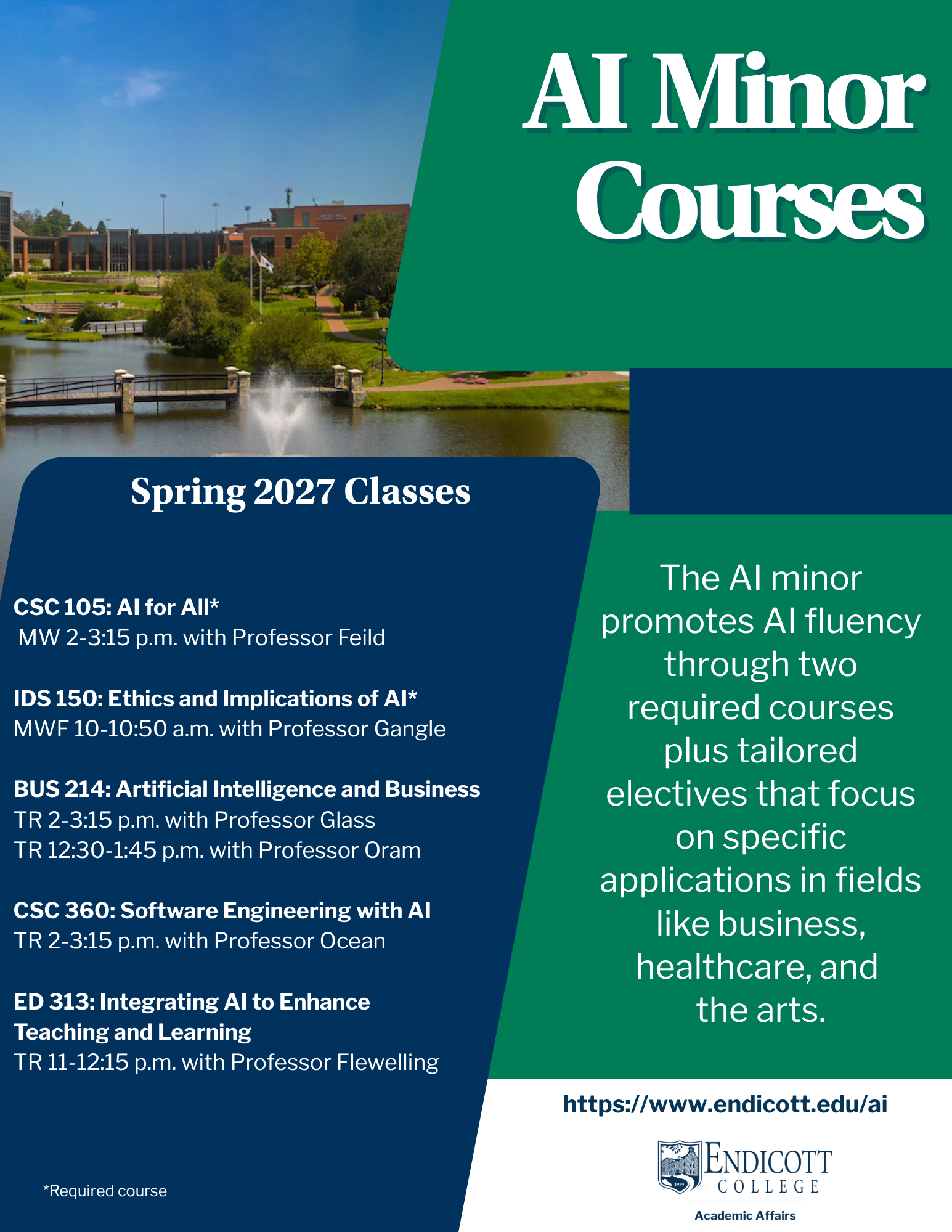
Program OverviewAs artificial intelligence transforms the world in which they live and work, students across disciplines are eager to understand these changes and build a deeper knowledge of AI. To meet this need, the proposed minor offers a structured path for students to develop both practical fluency with AI tools and a critical understanding of their history, limitations, and implications. Two required courses introduce the history and key principles of AI and machine learning while also addressing the major ethical, social, and economic issues raised by these technologies. Students complete the minor by selecting four electives from a list of courses that focus on specific applications of AI in business, computer science, education, healthcare, sport management, the humanities, and the visual arts. These offerings include at least one course from each of Endicott’s academic schools, allowing students to tailor the minor to their chosen field while also drawing interdisciplinary connections. The minor promotes AI literacy through a combination of technical understanding, practical skill development, critical evaluation, and ethical discernment.
-
Curriculum
Program Requirements
Students are required to take a minimum of 18 credits as follows:
Required Courses
-
CSC 105 - AI for All (Cr: 3)
-
IDS 150 - Ethics and Implications of AI (Cr: 3)
Additional Courses
-
ART 220 - Generative AI in the Visual Arts (Cr: 3)
-
BUS 214 - Artificial Intelligence + Business (Cr: 3)
-
CSC 460 - Advanced Topics in Artificial Intelligence (Cr: 3)
-
ED 313 - Integrating AI to Enhance Teaching and Learning (Cr: 3)
-
ENG 342 - AI and Writing (Cr: 3)
-
HSC 320 - AI in Healthcare (Cr: 3)
-
PHL 240 - Mind, AI, and Society in the Digital Age (Cr: 3)
-
SM 270 - The Role of AI in Sport Management and Human Performance (Cr: 3)
View academic catalog and learning outcomes -
CSC 105 - AI for All (Cr: 3)
"A few years ago, there was a lot of stigma about using AI in day‐to‐day work, mostly because there was a feeling that one was ‘cheating’ by using it. Today, every industry is utilizing AI…I would encourage young professionals…to familiarize themselves with as many AI programs as possible and think about ways that it can benefit an organization by making tasks more efficient."
Mark Lepage ’21 M’23
Assistant Athletic Director for Recreation and Athletic Programs, Stonehill College
-
Balanced Approach to AI Usage
- Use AI as a tool to enhance productivity and efficiency, not as a replacement for human creativity or critical thinking
- Learn to leverage AI for mechanical tasks while maintaining personal vision and design
- Understand both the benefits and limitations of AI in various fields
-
Essential AI Skills
- Develop effective prompt engineering skills to get better results from AI tools
- Learn to fact-check AI-generated content as outputs can be inaccurate
- Master data analysis and pattern recognition using AI
- Understand ethical implications and privacy concerns related to AI usage
-
Industry-Specific AI Applications
- Marketing and Content Creation: Using AI for content ideation, copy editing, and basic marketing materials
- Design: AI tools for renderings, concept imagery, and design development
- Healthcare: AI for clinical documentation and treatment planning
- Finance: AI for data analysis and reporting
- Sports/Athletics: AI for statistics analysis and content creation
-
Workplace Considerations
- Generational differences in AI adoption may create tension in workplaces
- Awareness of organizational policies regarding AI usage
- Maintaining authenticity and personal voice when using AI-generated content
- Understanding data privacy and security concerns when using AI tools
"As AI becomes increasingly integrated into the workplace, students should focus on developing a foundational understanding of AI tools and how to use them effectively in creative and professional settings."
Kyle Johnston
Manager of Creative Services, HireClix