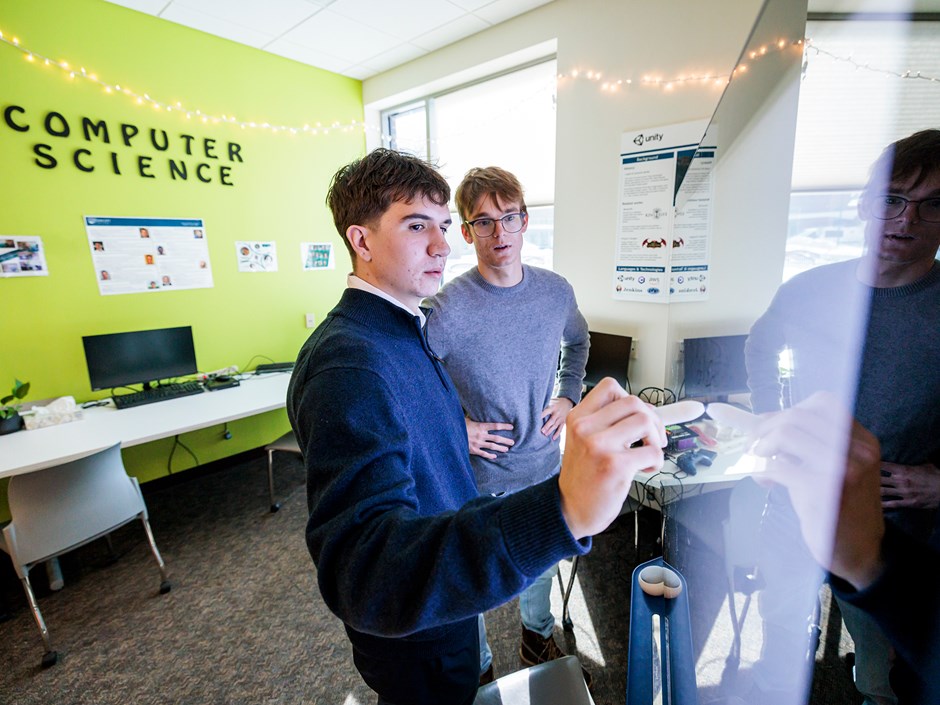
Artificial intelligence is reshaping higher education and the workplace, but at Endicott College, the focus is on helping students navigate what those tools mean and how they may be changing the ways Gulls learn and work.
Beyond those new skills lies a deeper question rooted in the broader human experience: what, in an AI-influenced world, still belongs to them? What does it mean to develop original ideas when a chatbot can generate an answer in seconds? How do students learn to trust their own voice and judgment?
On Endicott’s campus, those people-driven concerns are shaping how AI fits into the community.
At Endicott, the ubiquitous rise of AI is not a distraction from learning; it’s part of the work itself. As Sam Alexander, Associate Dean of Communication & Humanities and member of the College’s AI Council, explained, “There’s been so much discussion about AI as a threat to college. I think what that all misses is how well-positioned colleges are to create a space in which students can learn and think about these issues in a way that's reflective and critical.”
That kind of reflection is especially possible at a place like Endicott, where small classes and close faculty-student relationships create opportunities for conversation, experimentation, and trust. Rather than simply teaching students how to use AI, the College is helping them think more deeply about the kind of relationship they want to have with these tools—especially as they begin encountering them in internships and future careers.
Before entering the workforce, students have room to wrestle with what AI means for creativity, ethics, labor, and human connection. Grounding the campus-wide approach is a simple principle: technology should support human learning and judgment, not replace it.
AI in the Classroom: A Continuum of Adoption
A key aspect of Endicott’s exploration of AI in the classroom is giving faculty the avenues and autonomy to approach it in ways that best reflect their disciplines, course goals, and educational values. That means some faculty are actively experimenting with AI tools, some are intentionally preserving AI-free spaces, and many are somewhere in between.
In writing or creative classes, for example, the emphasis may be on helping students develop their own voices using tools like handwritten journals, while a more industry-facing course may be integrating AI more directly as a professional tool students will need to be familiar with.
Associate Professor Jennifer Flewelling is helping provide faculty support through a series of monthly workshops and the launch of two AI-focused Professional Learning Groups (PLGs). Flewelling said faculty PLGs are still fairly unique in higher education and go beyond presentations to bring together a collaborative cohort of educators who meet regularly to learn with and from one another.
“There is so much collective knowledge and expertise within the Endicott community,” explained Flewelling. “I am thrilled that we are making space for educators to gather and support one another in this moment.”
Aside from the practical aspect of learning that comes from PLGs and workshops, Alexander is interested in how AI fits into the classroom dynamic.
“A lot of what I find exciting now is not so much the technology, but thinking about what it means to work alongside this new form of intelligence,” he shared. “We bring training and experience that our students can learn from. But we're also learning alongside them in ways we’re not always used to. Part of all good teaching is discovering things together.”
As the College’s Instructional Technologist & AI Innovation Specialist, James Faulkner works outside the classroom to empower the campus’s AI pioneers and equip leadership with the foundations needed to tackle thorny issues, as well as build student skillsets.
“Most of all, I try to foster the critical thinking we desire from our students—to separate what nourishes us from what does not nourish us,” he explained. “In that sense, I hope to be a critic who helps our community find good use cases for AI and avoid the bad ones.”
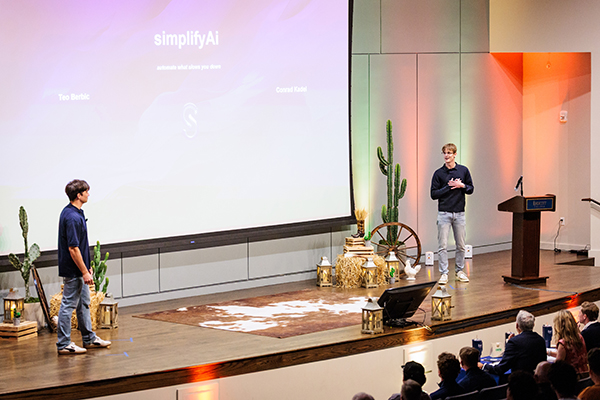
Computer science major Conrad Kadel ’26, the co-founder of simplifyAi, a business he started with computer science major and partner Teo Berbic ’26 as an internship, said he sees Endicott gaining momentum in AI use.
“You can feel Endicott wants to get ahead of AI,” shared Kadel. “Everyone really wants to engage in the topic, even outside of computer science.”
Introducing AI Across Disciplines
As faculty explore what AI means for teaching, the College is also building more formal academic pathways for students who want to study it in depth. Cross-school teams have been working to integrate AI into the curriculum, not simply as a technical specialty but as an interdisciplinary subject that touches nearly every field.
First offered this spring, the new AI: Theory and Practice minor includes required coursework that brings together technical, philosophical, and ethical perspectives. Through electives that span multiple disciplines, students can explore how AI intersects with business, education, healthcare, visual arts, sports management, and more.
Soon, Gulls will be able to pursue AI concentrations for bachelor’s degree programs in computer science, applied math/data science, and business analytics.
“In the business school, we’re focused on helping students apply AI to real problems: testing ideas faster, understanding customers more deeply, and building ventures more thoughtfully,” explained Gina Deschamps, Chair & Executive Director, Colin and Erika Angle Center for Entrepreneurship. “We’re not teaching students to rely on AI, we’re teaching them to lead with it, thoughtfully and ethically, as part of building something meaningful.”
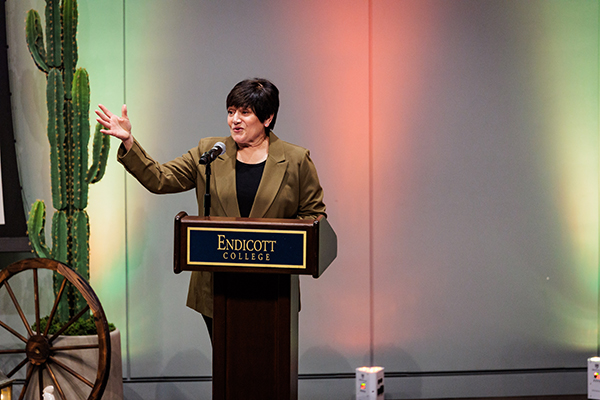
AI is finding its place in the humanities, as well. McCoy Endowed Distinguished Scholar Professor Charlotte Gordon shared her expertise via a digital reading platform that helps readers understand the nuances of Mary Shelley’s Frankenstein through a chatbot built on Gordon’s interviews. Alexander teaches his English students to use tools like Notebook LM to assist with analyzing research.
Professor of Philosophy Rocco Gangle is the co-founder of the Center for Diagrammatic and Computational Philosophy, which has brought a number of researchers to campus as part of the speaker series, “Ethics and Aesthetics of A.I.” All the talks have been structured to be accessible for both students and faculty from different disciplines around campus.
“With the rise of AI technologies that are suddenly relevant to so many different disciplines, the tools and techniques of diagrammatic and computational analysis are finding new relevance for bridging diverse kinds of knowledge, practice, and understanding,” said Gangle.
Building Skills for What Comes Next
Endicott has always used community connections to do what it does best: prepare students for successful careers. Conversations with business owners, internship site supervisors, and internship students paint a picture of what skills graduates will be expected to have, and over the past few years, that feedback has increasingly included AI.
For example, Quinncia is an AI-powered career preparation tool that helps students and job seekers create resumes and practice tailored mock interviews. Its capabilities highlight some of the more specialized uses of AI, such as scanning resumes for formatting errors, keywords, and structure to help bypass the applicant tracking systems used by most companies, or conducting and analyzing mock interviews with instant feedback on content, speech patterns, eye contact, and more.
Opportunities for applied, hands-on AI work will come to business and entrepreneurship students through the College’s new Innovation Complex, with its purpose-built lab space, collaborative project areas, and a sponsored capstone model in which student teams implement AI solutions for regional business partners.
“Part of our goal at Endicott is for students to constantly be connecting what they’re seeing in their internships and what they’re studying,” explained Alexander. “So, if they’re only seeing AI used out on their internships, or if they don't have any experience with it until their first job, I think we would not be serving them well in terms of workplace preparation.”
Especially in pre-professional majors, that knowledge could be the key to landing a coveted job.
“Most companies, especially small and mid-sized businesses, have plenty of access to AI tools but lack the people who know how to deploy them effectively,” added Glass. “That’s the gap we’re training our students to fill.”
The Careful Work Behind Endicott’s AI Strategy
To ensure the measured approach to AI is campus-wide, Endicott has established shared governance that fits within existing academic systems and conversations.
What that looks like today is a two-part approach: an AI Council, which addresses ideas, concerns, and emerging issues on a case-by-case basis, and an AI Steering Committee, which helps move larger questions into policy and institutional decision-making.
Associate Provost Chris Westgate, who co-leads the Council and Steering Committee with Chief Information Officer Amy Donovan, explained that equal representation of faculty and staff within the two bodies means they’re looking at questions, challenges, and resource allocation requests that impact the College as a whole, not just any single academic inquiry or concern. Donovan added that the topics discussed include sustainability and wellness, making it a true cross-section of representation.
Students are present, as well. Emily Vaughan ’26, student representative on the AI Council, said she appreciates the Council’s dedication to maximizing the benefits of AI tools while balancing potential ethical concerns and disadvantages.

“In my own field of criminal justice, I am wary of how these tools reinforce existing issues within the justice system like racial and social biases,” Vaughan shared. “I’d be excited to see how AI tools could be applied in other areas of the field, but until then, I am hesitant to fully embrace AI tools in my future work until there are more methods to address their ethical concerns. I am grateful to know that groups like Endicott’s AI Council are actively working on these very issues.”
That same balance extends to day-to-day operations. AI tools are already embedded in platforms the College uses, from Google to Canvas, but their adoption is measured. The emphasis is on identifying where AI can genuinely support human work without displacing it. For example, Alexander uses Google Gemini to confidentially summarize correspondence before meetings, and is working with Professor Mike Diehl on a chatbot that will help students determine what credits transfer from study abroad institutions, a task that can usually take hours.
Ultimately, the goal is not simply to keep up with a fast-moving technology, but to ensure that people remain front and center in the adoption conversation, said Westgate.
“At the end of the day, what we’re not willing to compromise on is ethical reasoning, critical thinking, and judgment,” he explained. “Whether we’re talking about AI literacy among students or AI integration and processes in offices, we’re always leading with empathy and with concern for human subjectivity, guided by an ethical framework that centers the human experience.”
A college degree may feel different in the age of AI, but its purpose remains the same: to help students think analytically, act ethically, and move through the world with purpose and their own voice. At Endicott, that will always remain the center of our mission, no matter what the future brings.