In the fall of 2025, biopharmaceutical company CAMP4 Therapeutics announced a $100 million funding round to move its RNA-based therapy for SYNGAP1 disorder into clinical trials.
The monumental announcement had been accelerated by the combined efforts of nonprofit leaders, vocal SYNGAP1 families, and Endicott students and faculty, including Associate Dean of Science and Technology Jessica Kaufman.
For Kaufman, the news was deeply personal: her eight-year-old niece, Hadley, who loves science fair projects and swimming, lives with SYNGAP1, a rare neurological disorder caused by a mutation in a single gene, often leading to seizures, intellectual differences, and autism.
“One of the hardest parts of having a rare disease is often just being seen,” said Kaufman.
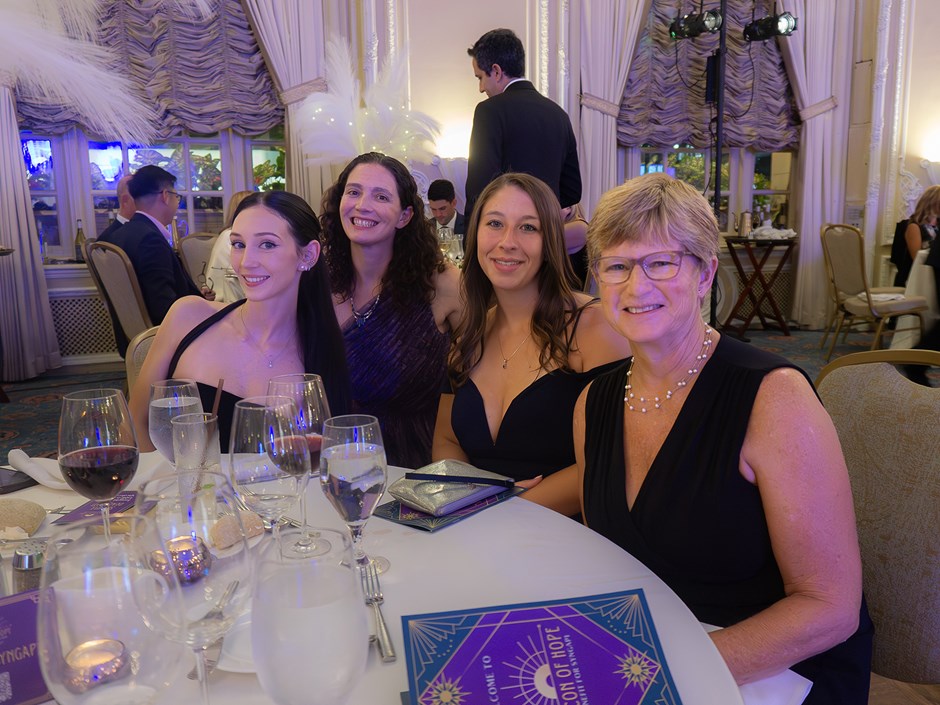
After CAMP4’s funding announcement, Kaufman invited Madison Tarasuik ’23 M’25 and Lisa Freed, adjunct faculty and internship advisor for Endicott’s new M.S. in bioinformatics, to attend the nonprofit CURE SYNGAP1’s annual fundraising gala at the Fairmont Copley Plaza in Boston.
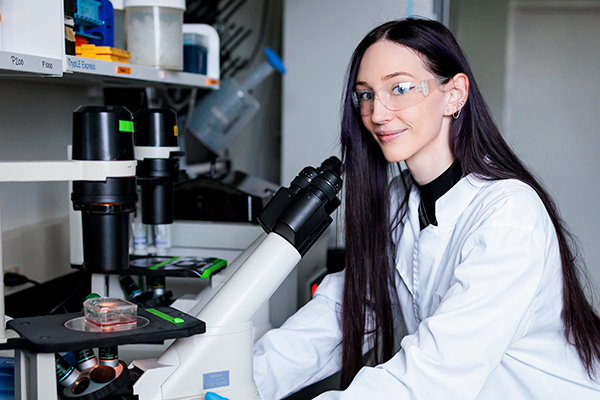
It was a full-circle moment for Tarasuik, one of the first graduates of the bioinformatics master’s program, and a burgeoning scientist who earned her B.S. in biology and biotechnology from Endicott, too.
As a student, Tarasuik had worked with a peer in her cohort, Jourdan Hourican M’25, to compare SYNGAP1 patient DNA sequences with those of each patient’s siblings to identify genetic markers of the SYNGAP1 disorder. As part of their degree, they partnered with CURE SYNGAP1, which supports research, treatments, and improved quality of life for patients.
“My internship in the master’s program made everything feel real,” said Tarasuik, now a clinical process development associate at the Broad Institute in Burlington, Mass. “In my classes, we worked with fabricated datasets or experiments that professors had already run and whose results we knew. The SYNGAP1 gene sequencing research I did was real patient data that had real implications.”
The graduate students’ internship also built on the previous research of Ahmad Bishara ’25, a computer science major who used his coding skills to develop a tool that aggregated SYNGAP1 data and made it more accessible to families and researchers.
At the gala in Boston, Tarasuik finally met Hadley and other SYNGAP1 families, bringing the implications of her work into stunning clarity. Alongside Kaufman and Freed, Tarasuik listened as SYNGAP families shared their everyday challenges and their dreams for a cure for all children.
Building the Science Behind the Breakthrough
Kaufman is uniquely positioned to go beyond just helping Hadley feel supported.
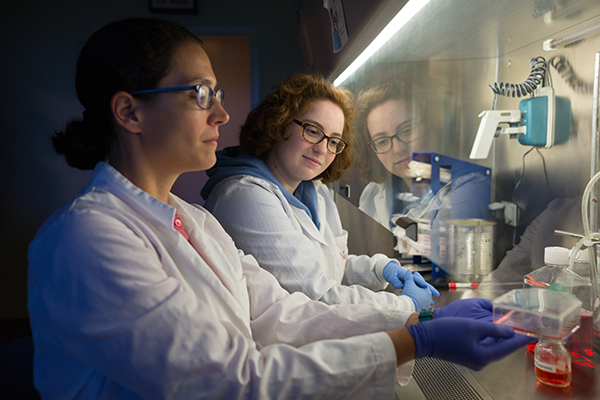
As a professor of biology and bioinformatics who helped establish the M.S. in bioinformatics program, Kaufman helps students apply data science to make discoveries in genomics and proteomics that benefit human health, including cutting-edge research on SYNGAP1.
Over the past few years, she has brought together specialized nonprofits, Endicott bioinformatics students, and the broader rare disease community to advance research toward a cure. In doing so, she created the perfect conditions for meaningful discovery.
Her students’ internship projects provided a proof of concept and data accessibility that made it impossible for a company like CAMP4 to ignore.
“The work that our students did, in tandem with CURE SYNGAP1, laid the groundwork for this clinical trial,” Kaufman said. “Madison and her colleagues’ work to get consent from the families and then to analyze the data helped remove friction and shorten the timeline that a normal clinical trial process entails.”
Now, that timeline is moving faster than Kaufman could’ve hoped.
Discovery and preclinical development phases are complete, and preclinical trials are ongoing. Clinical initiation could begin as early as this calendar year, starting phase one of the three-phase trial.
When Kaufman shared the news with Tarasuik over a celebratory dinner, Tarasuik couldn’t believe it.
“When you’re doing work like this every single day, you’re not always focused on the bigger picture. The funding made me realize that my work really mattered and it’s actually helping people; it’s about more than just doing it for a grade.”
The hands-on research experience offered by internships like Tarasuik’s is an obvious benefit to a graduate program—but students need mentoring as they examine what they like and don’t like about the experience.
Enter Freed, who has a decades-long career in education and guiding students, and is currently the competitions and programs partnerships manager at the education company CreXo. Freed has one other strong tie to the Nest: she’s an Endicott mom. Her son, Rob Ackerman ’20 M’21, is a double graduate and now an elementary school math teacher.
In her Bioinformatics Internship course, Freed coaches students and helps them to contextualize their internship experiences within their wider career ambitions.
For Tarasuik, Freed’s guidance was a welcome companion during a demanding time. “It was reassuring to hear that the trial and error I was experiencing during my work with the data was normal, because I kept thinking, ‘What am I doing wrong?’ She helped calm me down and to understand that everyone goes through this,” Tarasuik said.
From Freed’s perspective, getting something wrong is one of the most powerful parts of the process. Students start to understand exactly what they enjoy, and more importantly, what they don’t, which gives them an advantage once they graduate. They’re more focused and better attuned to their own strengths.
“The biggest thing I’ve learned from these students is that they are willing to ask a mentor, ‘Based on what I know I like to do, what are my options for a career?’ instead of, ‘This is my major, I need a job.’ That’s a huge difference,” Freed said.
That distinction became clear to Tarasuik during her internship and has helped shape her long-term goals. She sees real value in her current role at the Broad Institute, where she performs single-cell sequencing that enables analysis of data from individual cells.
Yet, she misses being on the impact side of things. Tarasuik’s time with CURE SYNGAP1 helped her to discover an innate desire to see her research through its full life cycle, or what happens when the data leaves her hands and how it impacts patients’ lives.
And for the next cohort, the work—and the potential impact—is only just beginning.
Back at Endicott, Kaufman, Freed, and this year’s bioinformatics students are working passionately towards a breakthrough, showing how multiple classes of Endicott students have used their hands-on experiences to build upon each other’s research and contribute to this shared goal.
Colin McNeil ’26 is picking up where Bishara left off by bolstering the variant viewing tool with additional data.
“Bioinformatics is a powerful tool for making strides in human health,” shared Kaufman. “These students are motivated by that and the impact it can have when combined with computer science and community support.”