Every few decades, a new technology changes the rules. The internet did it. Smartphones did it. Now, artificial intelligence is doing the same. As organizations rethink everything from daily workflows to long-term strategy, one thing has become clear: the future belongs to people who know how to work with AI—not simply around it.
Now, Endicott College is at the forefront of that trajectory. Through the new B.S. in Artificial Intelligence & Analytics Management, students will learn to look beyond the technology itself: understanding not only how to use AI, but when to use it, when to question it, and how to apply it responsibly across various industries.
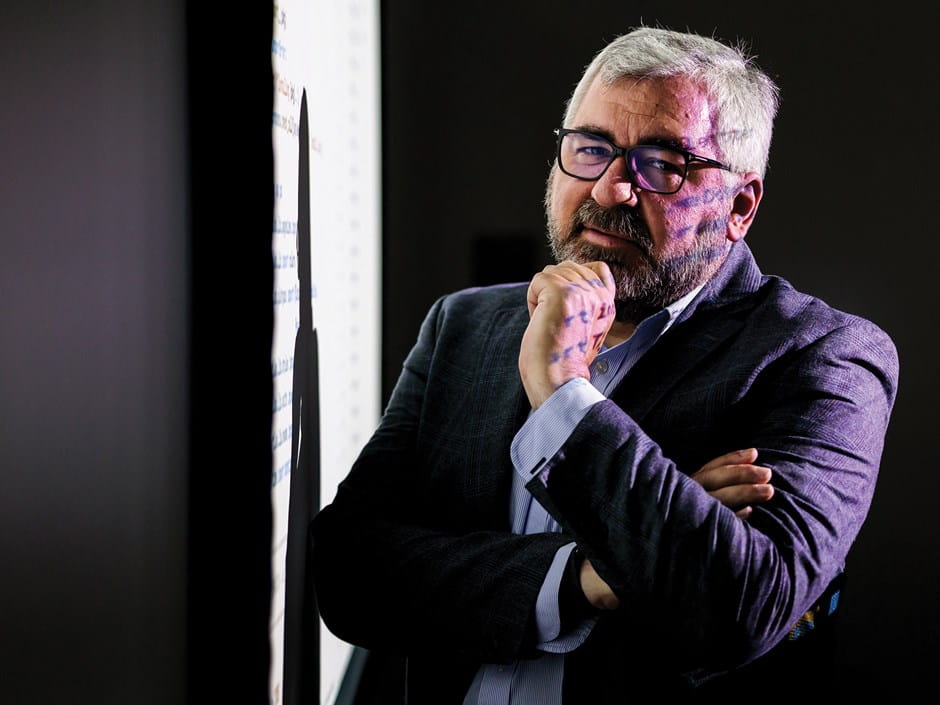
Dr. Allan Glass, Associate Professor of Management in the Gerrish School of Business, is part of the creation of this new academic offering. The former CIO of Pennsylvania Paper & Supply Company recently earned a Ph.D. from Clemson University and wrote his dissertation on how AI is reshaping organizations.
We recently sat down with him to learn more about AI’s growing impact on the workplace and where he sees it headed next.
Responses have been edited for clarity and length.
Endicott just launched the B.S. in Artificial Intelligence & Analytics Management degree. Why now, and why does it matter?
This was a Gerrish School of Business effort, and I was glad to be part of it. The design choice we cared most about is in the name: it’s an Artificial Intelligence & Analytics Management degree, not a data science degree. We weren’t trying to graduate students who build models; we wanted to prepare people who can lead organizations that run on AI, who can read analytics, ask the right questions, manage people and systems, and make judgment calls.
As for why now, organizations are already changing faster than the talent pipeline can keep up. My own research looks at how AI is transforming companies into genuinely new kinds of economic entities, and what kept surfacing is that the graduates who’ll matter most aren’t the ones who can train a model; they’re the ones who can lead a workforce that blends human and machine capability. That’s the gap we built this degree to fill.
What drew you to Endicott College and inspired you to teach here?
I came to teaching after almost three decades as a practitioner, so what drew me to Endicott was that it doesn’t treat the classroom and the real world as separate places. The experiential model matches how I believe people actually learn: by doing the work, not just reading about it. I wanted to teach somewhere that valued the scholar-practitioner bridge rather than asking me to choose a side. Working with students who’ll be in the workforce in a year or two keeps the stakes concrete. That immediacy is what keeps me here.
What role should colleges play in preparing students for the AI revolution?
Colleges have to be the place where students develop judgment, not just fluency. It’s relatively easy to teach someone to use a tool; the hard and durable work is teaching them when to trust it, when to question it, and how to think about the second-order consequences of deploying it. I worry about institutions that respond to AI with either panic or uncritical adoption, both of which abdicate the actual job.
Our responsibility is to graduate people who can work alongside these systems with discernment: who understand the technology well enough to use it, and understand its limits well enough to lead it. That’s why I’ve focused our AI literacy work on institutional problem-solving rather than tool demos. The literacy that matters is about judgment, not just operation.
How can young people prepare themselves to enter the workforce with AI’s arrival, and how do you temper fears that AI will replace most jobs?
I don’t dismiss the fear. It’s reasonable, and pretending otherwise insults people. But I’d widen the lens. New technologies don’t just eliminate work; they create entirely new markets, often faster than old ones contract. Every organization is now scrambling for people who can sit between the technology and the business, who understand AI well enough to deploy it but understand the operation well enough to know what’s worth deploying. That role barely existed three years ago, and it’s one of the most valuable seats in any company today.
So, my advice is to position yourself at those seams. The opportunity isn’t competing with AI on what it does well; it’s the work AI creates demand for: new products, services, and whole businesses that become viable only because the cost of intelligence has collapsed. A solo founder can run what used to take twenty people. A small nonprofit can deliver services it could never afford. The students I worry least about aren’t the ones avoiding AI or blindly trusting it. They’re the ones asking, “What can I build now that nobody could build before?”
What’s a piece of advice you’ve received that has stuck with you throughout your career?
Early on, someone I respected told me something I’ve never been able to shake: that I don’t actually own any of it. Not the title, not the organization, not the results ... I’m simply a steward of things that were entrusted to me, and stewardship is a heavier and more freeing word than ownership. It’s heavier because you’re accountable for what you’ve been given, not just what you’ve built yourself. But it’s freeing because it takes your ego out of the equation. When you lead as an owner, every setback is a wound and every win is a trophy.
When you lead as a steward, you can make the hard call, hand off the credit, or walk away from something you’ve poured years into because it was never yours to clutch in the first place. That shift has shaped how I serve on boards, how I run a business, and how I teach. It’s the difference between building a monument and building something that outlasts you.
Many alumni are excited about AI, while others are worried about what it means for their careers. If you could give our graduates one piece of advice about navigating AI over the next five years, what would it be?
Stay curious, not defensive. The instinct when a technology threatens to reshape your field is to protect what you already know how to do, but the graduates who thrive won’t be the ones who mastered a tool set in 2026 and stopped; they’ll be the ones who treated the next five years as a standing invitation to keep learning.
My advice is simple: get hands-on with AI early and often, not because you need to become a technologist, but because the fastest way to lose your fear of a thing is to actually use it. The people who sit on the sidelines waiting for AI to “settle” are the ones who’ll get left behind, because it isn’t going to settle. It’s going to keep moving, and the habit of staying a student for life carries you through it.
How can professionals—even those well into their careers—stay relevant as AI transforms the workplace?
The good news is that seniority isn’t a liability here. It’s an asset if you use it right. What AI can’t replicate is judgment built from years of watching decisions play out, reading a room, and knowing which problem is actually worth solving. So, the professionals who stay relevant are the ones who pair that hard-won judgment with a genuine willingness to use the new tools rather than delegate them to someone younger and call it a day.
What excites you most about the future right now, beyond just AI and technology?
Honestly, it’s what’s happening in my Organizational Behavior class. I’ve started pushing students toward bigger questions than they usually get asked at nineteen or twenty: not what job will I get but what kind of leader do I want to be, not how do I get hired but what do I want to be responsible for, and what do I want to leave behind. At first, it catches them off guard; most haven’t been invited to think about legacy or lasting impact yet.
But watching them take the question seriously, start wrestling with what their one life might add up to, is the most energizing part of my week. I think the moment demands it. When the technical ground shifts this fast, the only stable thing to build on is a clear sense of what you’re for. That’s the future I’m excited about: not the tools, but students learning to aim themselves at something larger than a paycheck.