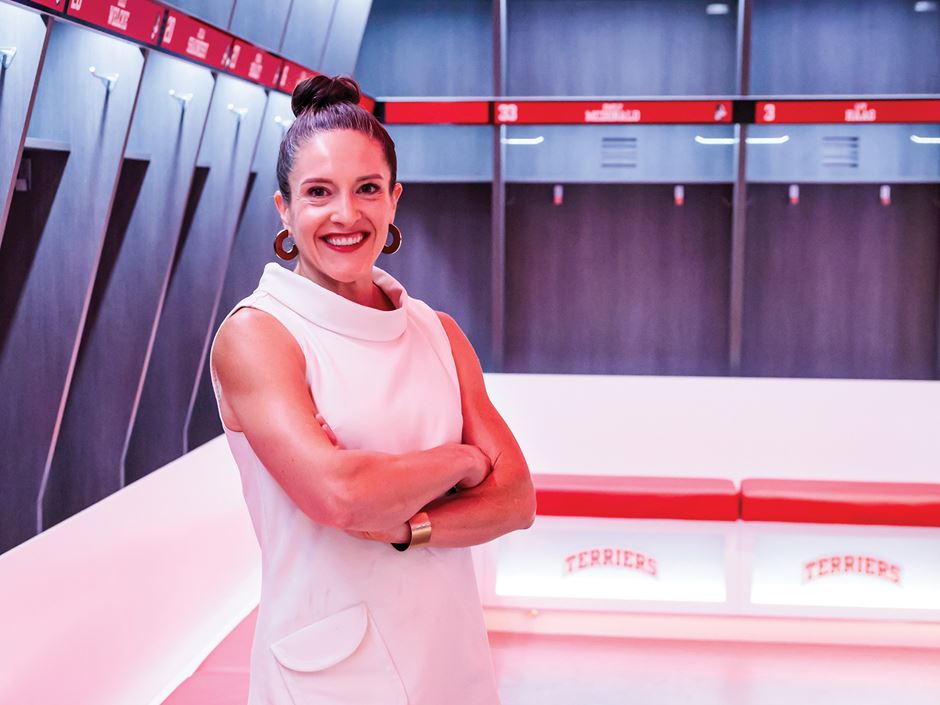
For Jennifer Williams ’08, the biggest compliment is not that people want to enter the buildings she thoughtfully designs with her team, but that they usually don’t want to leave.
And don’t even try to get Williams to reveal which space, or which special feature of any space, makes her proudest. Doing so would be akin to architectural blasphemy.
“It’s like asking me to pick my favorite child,” Williams said. “They’re all awesome in their own way.”
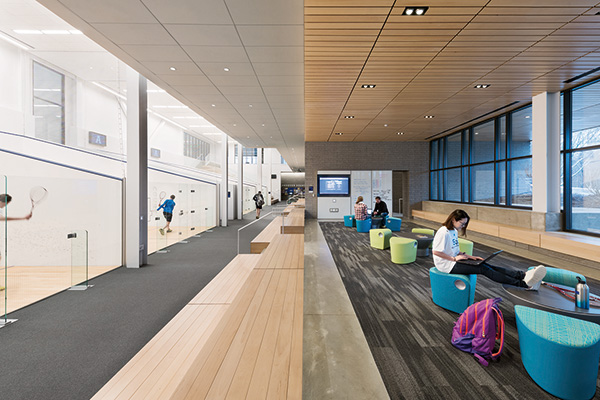
Those awesome spaces to which the Endicott alumna refers have become not only places for athletes to train, but for communities to gather. As a sports architect, Williams specializes in designing athletic centers, fitness spaces, and wellness hubs, primarily on college and high school campuses. As Managing Principal, Senior Interior Project Designer, and registered architect of the top-ranked global design firm Perkins & Will, Williams was a member of the Boston-based team that designed the Snyder Center at Phillips Academy in Andover, Mass., which opened in 2018. The reality that the space is serving others beyond its intended users is, for Williams, the mark of success.
“They have to kick people out at the end of the day because they’re just hanging out there,” she said. “You’re not only improving the experience of the people you expect to use the center, but building a community that’s more far-reaching.”
The niche career of sports architecture was not something Williams knew existed when she chose Endicott from her hometown of Blackstone, Mass. She was initially drawn to the scenic campus and the opportunity to play field hockey. When she decided to major in interior design (now interior architecture), she didn’t fully understand the complexity of the subject. Learning to balance extended hours in the studio while playing a varsity sport developed her time-management skills, and Williams credits her professors for trusting her to maintain that balance.
It was during her college internship at the architecture and design firm Sasaki Associates that Williams realized she could focus on athletic and recreational facilities. This internship led to a full-time position after graduation, where Williams worked on the soccer and lacrosse facility for Loyola University Maryland.
“Suddenly, I was designing spaces for student-athletes—an experience I’d just lived,” Williams said. “It was eye-opening, and that’s all I wanted to do after that.”
Building thoughtful spaces with the student-athlete in mind, while also welcoming everyone, requires a unique design philosophy that extends beyond functionality. Williams approaches sports architecture with a holistic understanding of wellbeing, encompassing mental health, recovery, and the integration of sports medicine, nutrition stations, and study lounges that acknowledge the limited time student-athletes have outside the classroom. Williams’ team-designed spaces incorporate biophilic elements and natural light, facilitating a stronger connection between humans and nature, which can help regulate visitors’ circadian rhythms.
“It’s everything from patterning of materials alluding to nature or bringing in plants to making sure building materials aren’t made with known carcinogens,” she explained. “These factors come into play when putting a building together.”
At St. Joseph’s University in Philadelphia, Williams was part of the Perkins & Will team that repurposed underutilized spaces within the athletic center for new uses, better serving today’s students. These new uses included wellness suites with recovery pods, massage chairs, and a mental health counseling office. Her work to expand and transform Northwestern University’s Ryan Fieldhouse and Walter Athletics Center incorporates a space for hydrotherapy and a residential kitchen, where a nutritionist teaches student-athletes how to cook healthy meals at home. An upcoming project to replace Matthews Arena at Northeastern University will offer a multipurpose space with a basketball practice facility, a recreation center for all students, and an ice rink for intercollegiate hockey. It will also feature innovative spaces, from sensory rooms to cryotherapy.
“There’s more emphasis on wellbeing,” Williams said, “mental and emotional health, and well-roundedness. Historically, sports facilities were insular and utilitarian, including just basics needed to perform a sport. Today, these facilities should be more welcoming, designed to be a home away from home.”
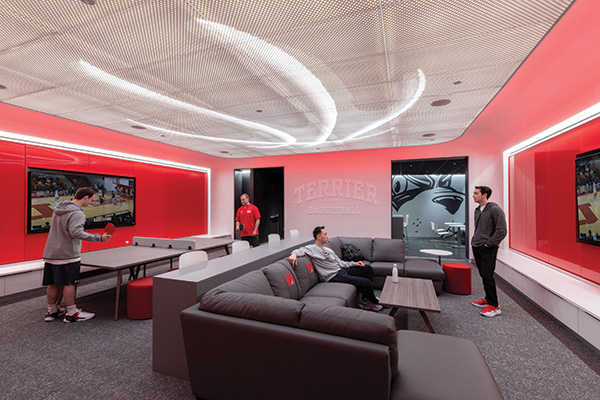
Following a recent renovation of the women’s hockey suite at Boston University, Williams’ measure of success was proudly reflected in the athletes’ habits. “Their season’s over,” she said, “and they still never want to leave.”
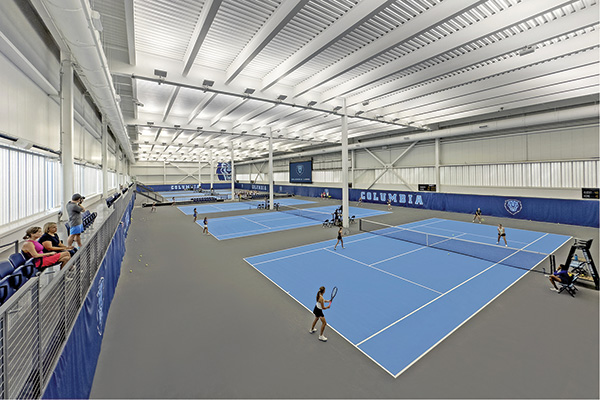
Photo credits, from top to bottom: Phillips Andover Academy, Snyder Center by Chuck Choi; Boston University, Men's Basketball Locker Room Suite, photo courtesy of Perkins&Will; Columbia University, Philip & Cheryl Milstein Family Tennis Center, by Eric Laignel